
Daviess County Tax Record Fields
Daviess County property tax records never sit in one combined file. Each office holds a different piece. The PVA record describes the parcel and its valuation. The Sheriff's bill reflects current collection status. The Clerk's delinquent list flags accounts that moved after the collection period closed. Reading all three keeps an old tax-roll name from being mistaken for present title. It also prevents a stale delinquent row from confusing the picture.
| Field | What It Shows | Where |
|---|---|---|
| Assessed value | Annual fair-cash-value estimate | Daviess PVA |
| Land and improvements | Parts of the total assessment | Daviess PVA |
| Exemptions | Reduction in the taxable base | Daviess PVA |
| Bill and status | Current charge, penalty, or payment | Daviess Sheriff |
| Delinquent bill | Owner, address, map ID, amount, status | County Clerk |
Kentucky taxes real property at 100 percent of fair cash value. That standard is a floor for assessment. A bill layers on rates and exemptions, and a deed may report an entirely different sale figure.
Daviess Tax Work Is Split
The Daviess County PVA values land and maintains the roll. Current bills go through the Sheriff Tax Collection office. After April 25, unpaid bills shift to the Clerk. The right record depends on the year. All of these offices sit at 212 Saint Ann Street in Owensboro. The PVA is in Room 102. The Sheriff tax office is in Room 103. Real property is assessed on January 1 under KRS 132.220. A deed recorded after that date can leave the prior owner responsible for that year's bill, the PVA cautions. The buyer may not reach the roll until the following year. A tax name is therefore not conclusive proof of current title.
Daviess Assessments Use Fair Cash
Assessment must sit at 100 percent of fair cash value. That rule comes from Section 172 of the Kentucky Constitution and KRS 132.191. The PVA may lean on sales comparison, cost, or income methods. Land and improvement values can total together. A farm parcel of at least 10 acres may qualify for agricultural value. That figure comes from rental and net-income data. It can sit below ordinary market value. Acreage alone does not prove the classification.
- Assessed value
- The PVA's annual value for tax work.
- Fair cash value
- The estimated price in a fair voluntary sale.
- Tax levy
- A rate applied by a taxing authority.
- Homestead exemption
- A qualifying reduction in taxable assessment.
- Tax lien
- A claim tied to unpaid property tax.
Look Up Daviess Tax Bills
The Sheriff links to the county's ProperlyTaxes lookup. Check the tax year first. Then search by address or by the exact map ID from the PVA before reading any balance.
- Search the Sheriff-linked system with the parcel address or map ID.
- Match the parcel and year before reading the amount and status.
- Compare the PVA assessment and exemption with the bill.
- For an unpaid bill after April 25, check the Clerk's tax-sale page.
The captured Daviess tax lookup target shows the official destination.
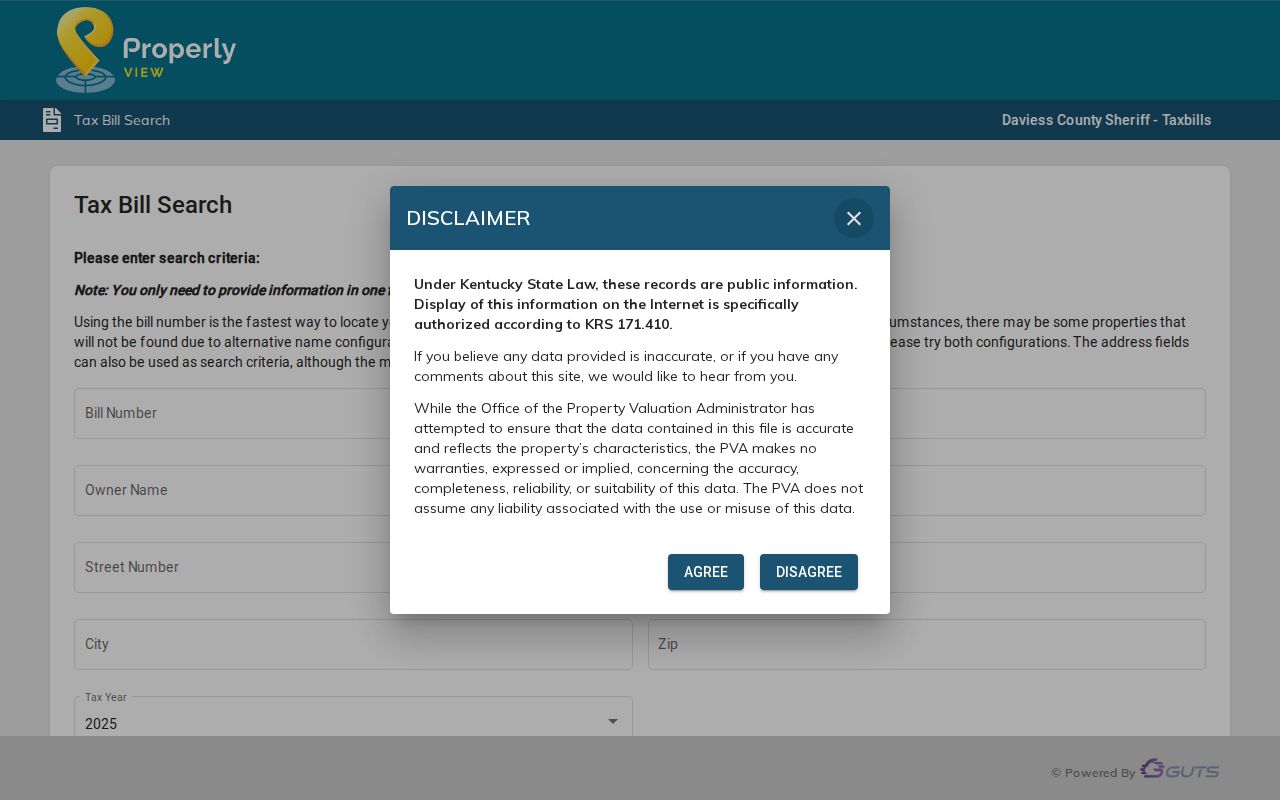
Read the lookup beside the Sheriff's current rules and the PVA assessment.
Daviess Property Tax Dates
Bills go out in early November. A 2-percent discount runs November 10 through December 10. The base amount holds through January 10. A 5-percent penalty applies through February 10. A 21-percent penalty then runs from February 11 through April 25. The Sheriff tax page spells out the payment channels as well, including online card, debit, and e-check payments, cash in person, and exact-amount check, cashier's check, or money order. Card fees are disclosed before payment, and a returned check carries a $25 fee under the KRS 514.040 citation on the page.

The calendar explains why the amount due changes across the collection cycle.
Daviess Exemptions Lower Taxable Value
The PVA FAQ lists a $49,100 homestead or disability deduction for 2025 and 2026. Homestead exemption covers a permanent residence. Its owner must be 65 or older. A spouse must meet the age test as well, and only one exemption is allowed per household. Total disability can also qualify under these rules. Named federal or Kentucky programs govern it, with proof and filing requirements, and the deduction changes taxable value rather than title or sale price, so confirm current forms with the PVA at 270-685-8474.
Daviess Delinquent Tax Lists
Delinquent notices go out on February 11. Unpaid accounts transfer to the Clerk after April 25. The Daviess Tax Sale page publishes annual lists. The 2026 PDF carries bill number, owner name, address, segmented map ID, amount due, and status. Some rows read "Not for sale." A listed bill is not always an auction offering. Sold bills can become liens and accrue interest, yet the PDF is a dated snapshot, so verify against the updated Clerk page and purchaser list before relying on it.
Daviess Tax Names Can Lag
The PVA tracks tax mailing addresses, not phone numbers. A mailing address can sit far from the property. An in-care-of name can route mail without touching legal title, and changing the form of the owner name may require a newly recorded deed. These distinctions slip past anyone reading a tax bill as an owner directory. Use the map ID and situs address together. A closing after January 1 changes the picture. Check the newest recorded deed and ask which party owed that tax year. The tax roll exists for assessment and collection. It is not a title report, and it may preserve the prior owner's name through the normal roll cycle.
Keep Daviess Payment Evidence
A receipt proves only one thing. The parcel and the tax year must still match. Save the confirmation number plus a copy of the bill. The two will then line up later. If a balance looks wrong, call the Sheriff's tax office at 270-685-6133 with collection questions. The PVA does not post or trace payments.
Once a bill transfers to the Clerk, ask there for the current delinquent status. Ask about current fees as well. A PDF amount can age quickly. The Clerk's sale material may also separate protected bills from those offered to third-party purchasers. Read Daviess County property tax records as dated steps in one process. The live custodian supplies the current payoff.
Challenge a Daviess Assessment
Kentucky gives taxpayers a 13-day inspection window that opens on the first Monday in May. The first step is a conference with the PVA. Bring whatever evidence fits. Good options include comparable sales, an appraisal, photos, repair estimates, or facts showing an error in the parcel record.
No resolution there? File with the county board of assessment appeals no later than one workday after the inspection period closes. From there, review can move to the Kentucky Board of Tax Appeals. Circuit Court is the last stop.
Protect the deadline. Finish the PVA conference and file the county-board appeal by one workday after the May inspection period closes.
Build Daviess Assessment Evidence
A good assessment conference stays focused on fair cash value as of the assessment date. Comparable sales should resemble the subject parcel in location, size, age, use, and condition. Photographs and repair estimates can show damage or deferred work that the PVA card misses. A professional appraisal helps too. Its date and method should fit the year under review. The bill feeling high is not the issue. The issue is whether the assessment meets the statutory value standard.
Check the Daviess County property record for flat errors before arguing value. Acreage, building square footage, condition, use, land classification, and improvement details all move the result. The PVA says inaccurate property information may be corrected by phone or in person. During the required conference, ask whether a factual correction settles the matter. Ask whether a county-board appeal is still needed. Keep copies of everything submitted, and note the date and the person who received it.
Kentucky accepts three valuation methods. Sales comparison, cost, and income each fit different facts. Recent comparable sales often speak to a house. Construction and depreciation facts bear on the cost approach. Income and expense records matter for income-producing land. Agricultural land follows its own use-value rules. A homestead or disability exemption shrinks the taxable base rather than the fair-cash-value estimate.
Daviess Tax Records Stay Dated
Every Daviess County property tax source is a snapshot. The January 1 roll fixes the assessment for that cycle. The Sheriff's payment record shifts as discounts, base charges, penalties, and payments pass through. The Clerk's delinquent list captures a later stage. It may mark a bill as protected or not for sale. Whenever you save a result, record the year and the inspection date.
Know what each document can prove. A paid bill covers the matched parcel and year, not clear title. A delinquent row does not mean a sale occurred. A name on the roll may predate a recent deed. For decisions that turn on a current balance, use the custodian's live status. Use recorded deed records for ownership.
Note: Keep the parcel map ID, tax year, payment receipt, assessment notice, and appeal evidence together so each dated record can be checked.